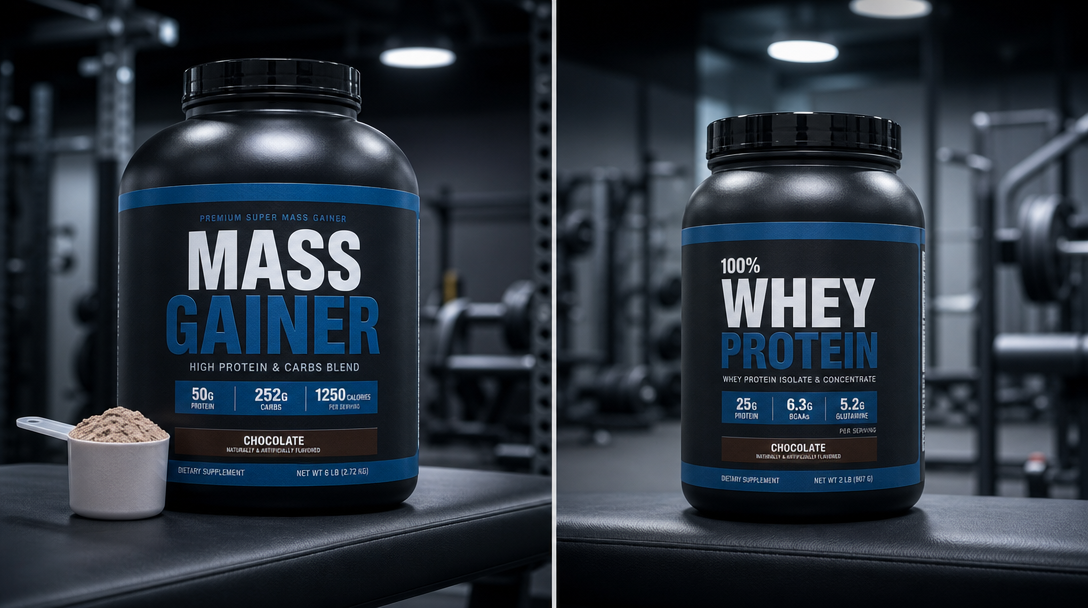
Mass Gainer vs Whey Protein: Which One Fits Your Goals?
If you've ever stood in the supplement aisle at Chemist Warehouse or scrolled through Bulk Nutrients trying to figure out what to buy, you've probably asked yourself this: do I need a mass gainer, or is standard whey protein enough? It's one of the most common questions Australian lifters ask — and the answer isn't as simple as "pick the one with more calories."
In this guide, we'll break down the real differences between mass gainers and whey protein, compare the nutrition and pricing, and help you determine which one actually aligns with your specific goals.
What Is a Mass Gainer?
A mass gainer is a high-calorie protein supplement designed to help you eat a massive calorie surplus — the kind that's hard to achieve from food alone. They're typically very high in carbohydrates (often 50–75g per serve) alongside a moderate dose of protein (20–30g), with fat content varying by product.
The idea is straightforward: if you're a hard gainer struggling to put on weight, or you're in a serious bulking phase with high training volume, mass gainers help you hit the calorie totals required without spending four hours a day eating chicken and rice.
Typical mass gainer stats (per serve):
- Calories: 600–1,200 kcal
- Protein: 20–30g
- Carbohydrates: 50–100g
- Fat: 5–20g
What Is Whey Protein?
Whey protein is a fast-digested, high-protein supplement derived from dairy. It contains minimal carbohydrates and fat, making it a convenient way to hit your daily protein target without extra calories.
Whey is the most researched protein source in sports nutrition, and for good reason: it's a complete amino acid profile, rich in leucine (the key trigger for muscle protein synthesis), and mixes easily with water or milk.
Typical whey protein stats (per serve):
- Calories: 100–140 kcal
- Protein: 20–25g
- Carbohydrates: 1–5g
- Fat: 0.5–3g
The Core Differences
|| Feature | Mass Gainer | Whey Protein | ||---------|-------------|---------------| | Calories per serve | 600–1,200 kcal | 100–140 kcal | | Protein per serve | 20–30g | 20–25g | | Carbohydrates | 50–100g | 1–5g | | Best for | Bulking, hard gainers | Any goal (cutting, recomp, maintenance) | | Price per serve | ~$1.50–$3.50 | ~$1.00–$2.00 | | Digestion speed | Slow (due to carb load) | Fast (whey isolate) | | Suitability for cutting | Poor | Excellent |
When to Choose Mass Gainer
You're Struggling to Gain Weight
Some people — often referred to as "hard gainers" or ectomorphs — genuinely struggle to eat enough calories from whole food alone. If you have a fast metabolism, low appetite, or a demanding schedule that makes frequent eating difficult, a mass gainer can be the difference between stalling and growing.
A 2021 survey from the Australian Institute of Sport found that around 15–20% of resistance-trained individuals report significant difficulty meeting calorie targets through food alone — a group where mass gainers have a genuine, practical use case.
You're in an Off-Season Bulking Phase
If you're deliberately trying to put on size and strength, and your training is structured around progressive overload in the 8–20 rep range with a calorie surplus of 300–500 kcal per day, mass gainers can help you hit those numbers without forcing down seven meals a day.
You're a Young Male with High Training Volume
Athletes in their late teens and twenties with very high energy expenditure — think 90-minute gym sessions plus cardio — can burn through a enormous number of calories and need significant fuel to avoid catabolism.
When to Skip the Mass Gainer
- You're trying to lose fat: A mass gainer's carbohydrate content will blow out your calorie budget fast. Whey protein with a slight calorie deficit from whole food is the better approach.
- You're already eating enough: If your current diet already puts you in a calorie surplus, the mass gainer is just expensive sugar.
- You have poor insulin sensitivity: The massive carbohydrate doses in mass gainers can cause blood sugar spikes and crashes in some individuals.
When to Choose Whey Protein
Whey protein is one of the most versatile supplements you can buy. It fits into virtually any training goal.
You're Cutting or Recomping
If your goal is to lose body fat while preserving lean muscle mass, hitting a high protein target (1.8–2.2g per kg bodyweight) is critical. Whey protein lets you flood your system with amino acids at minimal calorie cost — ideal when you're in a deficit.
You Want to Preserve Muscle During Busy Periods
Travelling, working long hours, or skipping meals due to schedule chaos is a reality for many Australians. A whey shake as a meal replacement or snack keeps your protein intake on track without requiring a full meal.
You're Already Eating Well
If your diet is already on point — you're hitting your calorie and protein targets from whole food — then a mass gainer adds unnecessary bulk and cost. Whey bridges any small protein gaps at a fraction of the price.
Australian Market Comparison: What You'll Pay
Here's a snapshot of popular mass gainers and whey proteins from Australian retailers as of August 2026:
Mass Gainers
|| Product | Size | Price (AUD) | Protein/Serve | Calories/Serve | ||---------|------|------------:|-------------:|--------------:| | Optimum Nutrition Serious Mass | 2.7kg | ~$79.95 | 25g | 1,250 kcal | | MuscleTech Mass Tech | 2.3kg | ~$74.95 | 22g | 980 kcal | | MyProtein High Protein Mass | 3kg | ~$54.99 | 25g | 880 kcal | | Bulk Nutrients True Mass | 3kg | ~$52.00 | 23g | 870 kcal | | USN 4Gauge | 2.5kg | ~$89.95 | 30g | 780 kcal |
Whey Proteins
|| Product | Size | Price (AUD) | Protein/Serve | Calories/Serve | ||---------|------|------------:|-------------:|--------------:| | Optimum Nutrition Gold Standard | 2.27kg | ~$89.95 | 24g | 120 kcal | | MyProtein Impact Whey | 1kg | ~$34.99 | 21g | 103 kcal | | Bulk Nutrients Whey Protein | 1kg | ~$33.00 | 23g | 115 kcal | | Dairy Free Complete Whey | 750g | ~$44.95 | 24g | 120 kcal |
The Cost Per Gram of Protein
This is where it gets interesting for value-conscious buyers:
| Product Type | Approx. Cost per 100g Protein |
|---|---|
| Budget Mass Gainer | $1.80–$2.50 |
| Premium Mass Gainer | $2.50–$4.00 |
| Budget Whey Concentrate | $1.20–$1.80 |
| Premium Whey Isolate | $1.80–$2.80 |
Whey protein almost always wins on pure protein efficiency. You're paying primarily for protein, not carbs and calories. If your goal is to build muscle, protein is what drives that outcome — the carbs in mass gainers are fuel, not the driver of hypertrophy.
Mixing Them: The Hybrid Approach
A strategy some experienced Australian lifters use is splitting the difference: take a standard whey protein shake post-workout for muscle protein synthesis, and add a mass gainer either before bed or on non-training days to hit calorie targets.
This works well if:
- You have a genuine calorie shortfall that's hard to close with food
- You're an ectomorph who struggles to gain weight
- You're in a bulking phase but want faster post-workout recovery from whey
But it's not necessary for most people. If you're eating enough whole food, one or the other is sufficient.
What About Whole Food First?
Before spending money on either supplement, take a hard look at your current diet. A mass gainer shake at 1,000 calories is not nutritionally equivalent to a meal of chicken, rice, sweet potato, and vegetables. Whole foods provide fibre, micronutrients, and a more satisfying eating experience that supports long-term adherence.
The general rule in sports nutrition: supplements supplement — they don't replace a solid dietary foundation.
Expert Insights
"The biggest mistake I see is people buying mass gainers when they should be looking at their overall calorie intake from food first. Most people who think they 'can't gain weight' are actually undereating by less than 300 calories a day — that's one extra sandwich and a glass of milk. Mass gainers make sense for a specific subset of hard gainers, not the majority." — Accredited Practising Dietitian (APD), Sports Dietitian, Sydney
"From a muscle protein synthesis standpoint, whey isolate is one of the most effective tools we have. The leucine content and absorption rate are hard to beat. But if someone's total daily protein is already sufficient and they're in a bulking phase, the extra calories from a mass gainer can be genuinely useful — just not as a substitute for quality food." — Exercise Physiologist, Melbourne
The ProteinRanked Verdict
Choose Mass Gainer if:
- You have genuine difficulty eating enough calories from whole food
- You're in a structured bulking phase with high training volume
- You're a young athlete with very high energy expenditure
- Your goal is maximum weight gain (not necessarily lean mass)
Choose Whey Protein if:
- You're cutting, recomping, or maintaining
- You want to preserve or build lean muscle on a budget
- Your diet already covers your calorie needs but protein might be slightly low
- You prefer a simpler, more versatile supplement
Consider both if:
- You're a hard gainer in a serious bulking phase
- You train twice a day or have very high energy demands
Both products have legitimate use cases. The key is being honest with yourself about your actual dietary intake and training goals — not just buying what the supplement marketing tells you to.
Last updated 2026-08-10. This guide was researched and published by the ProteinRanked Team for Australian consumers. Prices reflect typical retail at major Australian supplement stores as of August 2026 and may vary by promotion. Protein powder and mass gainers are dietary supplements, not replacements for whole foods. For personalised nutrition advice, consult an Accredited Practising Dietitian (APD).